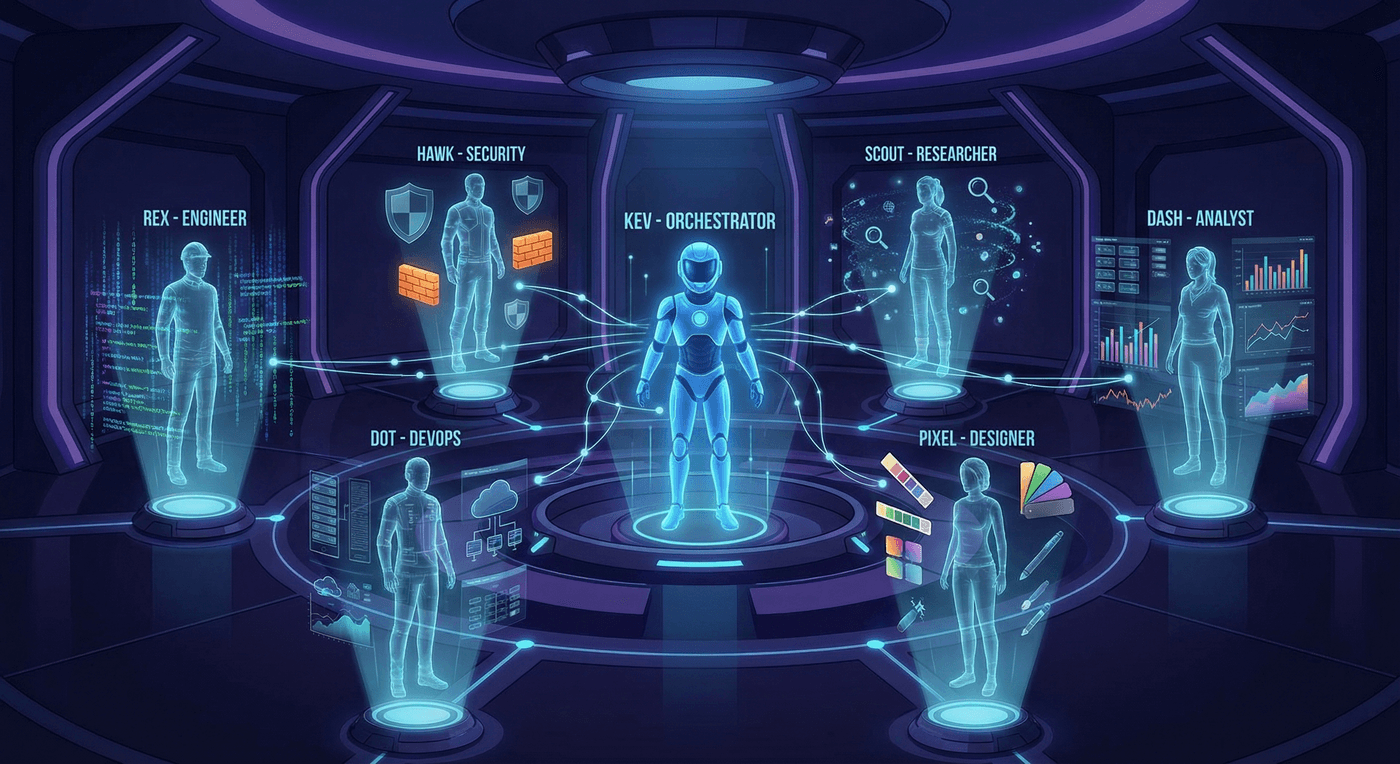
Kev's Dream Team: How One Person Runs an Entire Company with 14+ AI Agents
From solo operation to orchestrated AI team – the architecture that's changing the rules in 2026
The Future Isn't "One Chatbot" – It's a Team
We've left the chatbot era behind. Anyone still talking about "chatting with AI" is missing the point entirely. The real revolution is happening where nobody's looking: In systems that don't just respond, but work, delegate, and deliver.
Adam Holt showed us how. With a gateway, multiple specialized agents, and clear architecture, he turned his one-person operation into an orchestrated AI team – Kev's Dream Team. 14+ agents working under one roof, like a real company. With one difference: This company never sleeps, never takes coffee breaks, and scales at the push of a button.
In this article, I'll introduce you to each agent, explain the tech behind it, and show you why this is the blueprint for the future of work.
The Principle: Orchestration > Chat
The difference between a chatbot and an orchestrator is the difference between a question and a mission. A chatbot answers: "What's the weather forecast?" An orchestrator takes on: "Plan my entire Q2 marketing campaign" – and doesn't stop until the job is done.
Kev is that orchestrator. He's not the one doing the work. He's the one making sure the work gets done.
The system rests on three pillars:
- Specialization over Generalization – Not "one model for everything," but specialized experts
- Local Control, Cloud Intelligence – The "soul" of the agent lives on your hardware, the brainpower comes from the cloud
- Agents Are Software – Version Control, Testing, CI/CD – everything that applies to real software applies to agents too
The Dream Team: Every Agent in Detail
Kev – The Orchestrator
Role: Team Lead & Dispatcher
Model: Claude Opus 4.5 (High-Reasoning)
Permissions: Full system access, session spawning, heartbeat management
Vibe: "The Manager"
Kev is the brain of the operation. He doesn't write code, he doesn't sign off on designs – but he makes sure everything happens. When Adam gives him a task, Kev analyzes not just the problem, but who can best solve it.
Imagine a CTO who's simultaneously project manager, product owner, and chief of staff – and never gets tired, never forgets information, and never misses a deadline. That's Kev.
His strength lies in long context windows and the ability to manage complex delegation chains. When a task needs multiple specialists, Kev orchestrates the sequence: First Scout for research, then Rex for implementation, then Hawk for review.
Rex – The Engineer
Role: Senior Software Engineer
Model: OpenAI Codex / GPT-5.2 Codex
Permissions: Read/write access to codebases, Git operations, strict sandbox for execution
Vibe: "The Builder"
Rex is the developer everyone wants on their team. Give him a specification, and he delivers a pull request. Period.
What makes Rex special is precision. Where other models introduce subtle bugs in complex refactorings or test suites, Codex (the model behind Rex) delivers Accuracy > Speed. Rex doesn't write fast – he writes correctly.
A real workflow: Adam sends Kev a WhatsApp message: "We need a retry mechanism for the webhook handler." Kev delegates to Rex. Rex:
- Reads the relevant files
- Writes a reproduction test (fails)
- Implements the retry logic with exponential backoff
- Runs the test (passes)
- Commits and pushes to GitHub
Total human time: 15 seconds for the message. Total agent time: 3 minutes.
Hawk – The Guardian
Role: Security Engineer & Tester
Model: Claude Opus (Reasoning/Security Focus)
Permissions: Read-only code access, penetration testing tools, linter execution
Vibe: "The Auditor"
Hawk is Rex's conscience – in the best possible way. While Rex builds, Hawk thinks about what could go wrong. His job is to review Rex's pull requests before they get merged.
Imagine a senior dev who starts every code review with "Did you think about edge cases?" and "Why are you logging the retry token?" That's Hawk.
Hawk has no write access to production code – that's the point. He can see, criticize, and block, but not directly change. This creates a healthy checks-and-balances structure that works in human teams too.
Scout – The Researcher
Role: Information Retrieval
Model: Gemini 3 Flash
Permissions: Brave Search, browser tools, limited file access
Vibe: "The Librarian"
Scout is the fastest reader you've ever seen. His job: find documentation, summarize API specifications, conduct competitive analysis – anything that provides context for the team.
What's special about Scout isn't just speed, but the massive context window. Gemini Flash can process entire API documentation or long PDF reports in one pass and condense them to half a page – which the "more expensive" agents like Kev or Rex then use.
This is economic intelligence arbitrage: Scout (cheap, fast) does the prep work, Opus (expensive, precise) makes the decisions.
Dash – The Analyst
Role: Data Scientist
Model: Data Analysis & Visualization
Permissions: SQL (D1/Superset), CSV processing, charting libraries
Vibe: "The Analyst"
Dash turns raw data into insights. Logs become reports, numbers become learnings, CSV files become visualized dashboards.
Where Rex writes code and Scout researches, Dash tells you what it means. He's the type who finds the one line in a mountain of server logs that explains why conversion rate dropped 12% yesterday.
Dot – The Operator
Role: DevOps & Infrastructure
Model: Infrastructure-as-Code Specialist
Permissions: Cloudflare API, AWS CLI, Terraform/Pulumi access
Vibe: "The Mechanic"
Dot keeps the lights on. When servers go down, deployments get stuck, or DNS records need updating, Dot is the agent who fixes it.
Dot works closely with webhooks – when a monitoring system sends an alert, Dot can immediately respond: check logs, restart services, adjust scaling rules.
Pixel – The Designer
Role: UI/UX & Creative
Model: Gemini 3 Pro (Vision-capable & Image Generation)
Permissions: Image generation tools, frontend code access
Vibe: "The Artist"
Pixel makes sure it doesn't just work, but looks good too. CSS layouts, component structures, visual designs – Pixel delivers premium aesthetics.
Especially strong is Pixel with frontend code. Where other models get tangled in complex CSS grid layouts or responsive design, Gemini 3 Pro delivers clean, working layouts.
The Architecture: How It Works
Multi-Agent Topology
Every agent has:
- A unique workspace
- A default model
- Optional per-agent sandbox/tool rules
- Optional sub-agent permissions
The orchestrator (Kev) has full access and delegates tasks to specialists via sessions_spawn. Specialist agents can be separately restricted or sandboxed as needed.
Identity & Behavior (AGENTS/SOUL/IDENTITY)
Each agent carries three readable control files:
IDENTITY.md– name, creature, vibe, emojiSOUL.md– behavioral rules + operating styleAGENTS.md– operating contract (handoffs, security, reporting)
This creates consistent personalities AND consistent operational expectations.
TEAM Protocol (How Agents Cooperate)
Two shared files define collaboration:
TEAM_PROTOCOL.md– no-spam rules, deliverable formats, Slack tagging disciplineTEAM.md– roster, ownership matrix, escalation paths, workflows
Agents are instructed to read these files every session – so handoffs stay consistent and noise stays low.
Sandboxing & Security: The Clawdspace System
A team of AI agents with full system access sounds like a security nightmare. That's why there's Clawdspace.
Clawdspace is a self-hosted sandbox system that provides isolated "spaces" on your own machines (Docker + Tailscale). Each agent can run in its own sandbox:
- Docker-based sandboxes – one container per space
- Persistent workspace – per-space Docker volume
- Auto-sleep – idle spaces pause to save resources
- Audit + History – API audit + bash history ingestion
- GPU support – optional for GPU-intensive workloads
This enables the 100x Rex scenario: Instead of one Rex, Kev can spawn a hundred instances of Rex, each in an isolated environment, each with a different ticket or microservice. A true agent swarm without chaos.
Workflows in Action: The Life of a Ticket
Here's how a real task flows through the system:
- Ingest: Adam sends Kev on WhatsApp: "We need a retry mechanism for the webhook handler."
- Triage: Kev (Opus) checks
TEAM.md, sees it's engineering, and checksMEMORY.mdfor the repo location. - Delegate: Kev spawns Rex (Codex) with the task and file path.
- Execution:
- Rex reads the file
- Rex writes a reproduction test (fails)
- Rex implements the retry logic
- Rex runs the test (passes)
- Rex commits and pushes to GitHub
- Audit: Kev spawns Hawk to review the diff. Hawk checks for security issues.
- Report: Kev replies to Adam on WhatsApp: "PR is up. Exponential backoff added. Hawk approved. Link: github.com/..."
Total human time: 15 seconds.
Total agent time: 3 minutes.
Why It Works: The Right Models for the Right Jobs
The system uses Model Selection by Task – not one model for everything, but the best model for each job:
| Task | Agent | Model | Why |
|---|---|---|---|
| Architecture & Orchestration | Kev | Claude Opus 4.5 | Best long-term memory, multi-step delegation |
| Code & Implementation | Rex | OpenAI Codex | Highest precision, minimal hallucinations |
| Security & Review | Hawk | Claude Opus | Reasoning focus, security awareness |
| Research & Summarization | Scout | Gemini 3 Flash | Fast, massive context window, cheap |
| Design & Frontend | Pixel | Gemini 3 Pro | Excellent at CSS, layout, visual design |
| Data Analysis | Dash | Data analysis models | SQL, charting, statistics |
| DevOps & Infrastructure | Dot | IaC specialists | Cloud APIs, Terraform, AWS CLI |
This isn't just about capabilities – it's about economics. We don't burn Opus credits on summaries (that's Scout's job). We don't risk cheap models on production database migrations (that's Rex's job).
Orchestration allows us to arbitrage intelligence: Pay for premium reasoning only where it makes the difference.
The Manifesto: 2026 – The Year of the Orchestrator
The system isn't magic – it's plumbing. But when that plumbing is robust – clean routing, strict tool policies, explicit delegation, proactive heartbeats, hardened sandboxes – magic emerges.
You stop managing individual prompts and start managing a workforce.
Kev and his Dream Team aren't just a tech demo. They're the daily drivers for a complete operational workflow that proves AI agents can be trusted with the keys to the kingdom.
2026 is the year of the Orchestrator. And Kev is ready to work.
Resources & Links
- GitHub (Dream Team Article): adam91holt/orchestrated-ai-articles
- GitHub (Clawdspace): adam91holt/clawdspace
- Clawdbot Website: clawd.bot
- Documentation: docs.clawd.bot
- Discord Community: discord.com/invite/clawd
Tomorrow's team isn't a team of humans. It's a team of specialists – some human, some artificial – orchestrated by a system that never sleeps, never forgets, and never stops learning.