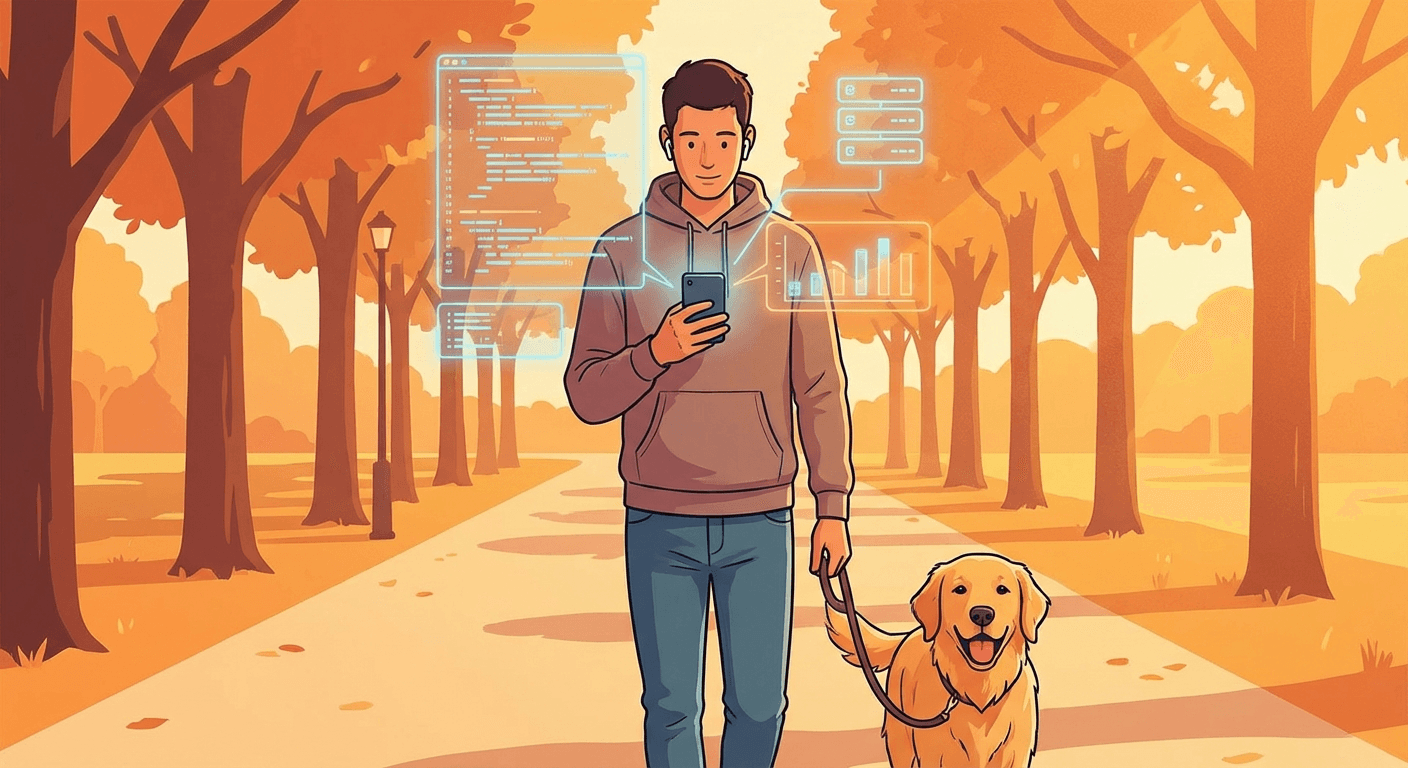
Voice-Controlled DevOps: How a Developer Manages Infrastructure While Walking the Dog
AI assistants aren't just for chat anymore – they're taking over complete DevOps workflows. Hands-free, in real-time, while the dog does his business.
The Scenario That Changes Everything
Imagine: You're out walking your dog. The sun is shining, the fresh air feels good. Suddenly your phone vibrates – a build just failed on Railway.
In the old days, that meant: Rush home, open the laptop, dig through logs, consult Stack Overflow, adjust configs, redeploy.
Today? You speak a sentence. Your agent takes over.
What Actually Happened
An OpenClaw user – let's call him BigC – did exactly that. His agent runs on a Hetzner server and monitors his Railway deployments. When a build failed:
- Log Analysis – The agent read the error messages, identified incorrect build commands as the root cause
- Fix & Deploy – He updated the configs, triggered a new deployment, and confirmed success
- Code Review – When BigC identified a design issue, the agent reviewed the code, fixed the problem, and submitted a PR
All via voice. While walking. Without ever opening a laptop.
Why This Is More Than Just "Convenient"
This isn't "chatbot answers questions." This is true delegation. The agent acts on behalf of the user, not just as an advisor.
The difference is subtle but fundamental:
| Traditional Chat | True Delegation |
|---|---|
| "Here are the logs, what do you think?" | "Fix it and let me know" |
| Prompt → Response → Human Action | Intent → Autonomous Execution → Confirmation |
| Human is the Executor | Agent is the Executor |
What This Means for Developers
For Solo Developers: You have a DevOps engineer who never sleeps, never gets tired, and is ready to patch your server at 11 PM in a parking lot.
For Teams: The escalation chain changes. Instead of "Page the on-call engineer," it becomes "Let the agent try to fix it – and page only if it gets complex."
For Work-Life Balance: The boundaries blur, yes. But they blur in both directions. When critical fixes take 5 minutes instead of 2 hours, you get time back. For the walk. For family. For yourself.
The Tech Behind It
What makes this possible?
- Server-based Agents – Not just a browser chat tab, but a persistent process with API access
- Tool Use – The agent can execute commands, call APIs, operate GitHub
- Continuous Context – He knows your project, your configs, your preferences
- Multi-Modal – Voice input, text output, but actions in the real world
A Glimpse Into the Future
We're at the beginning. What works today with Railway and GitHub will work tomorrow with AWS, Kubernetes, Terraform, and every other Infrastructure-as-Code solution.
The question is no longer: "Can an AI assistant do that?"
The question is: "Which workflows do you want to delegate – and which do you keep in your own hands?"
Conclusion
BigC's dog has no idea he witnessed a small revolution. But for developers worldwide, this means: The way we operate software is fundamentally changing.
From "I have to sit at a computer to control systems" to "I can be anywhere and my infrastructure works for me."
This isn't just more convenient. This is a new category of productivity.
Ready to automate your own workflows? With OpenClaw, you build your personal DevOps assistant – for server management, deployments, or complete CI/CD pipelines. Get started here.